









This one is a bit late. And this is not so much a review as a recommendation.
In this week’s edition of Add to Watchlist, we have Even If This Love Disappears from the World Tonight (2022). Yes, the Japanese one.
When I reviewed the Korean remake, I noticed a recurring comment on Letterboxd. People kept saying it was good, but not as strong as the original. That got me curious. I genuinely loved the Korean version. My rating reflected that. But after going back and watching the Japanese film, I have to admit something.
You guys had a point. Watching the Japanese version does not reduce the affection I have for the Korean film. I want to make that clear. But when two films are this close in quality, you naturally begin to notice the smallest differences. And in those small margins, the Japanese version edges ahead.
Only slightly. But it does.
Detail | Information |
Title | Even If This Love Disappears from the World Tonight |
Year | 2022 |
Country | Japan |
Director | Takahiro Miki |
Starring | Riko Fukumoto, Shunsuke Michieda |
Genre | Romantic Drama |
Based On | Novel by Ichijo Misaki |
Also Adapted As | 2025 Korean remake by the same name |
Before you come at me, let me explain. Also, major spoilers ahead for both films. The Japanese version feels more lived in.
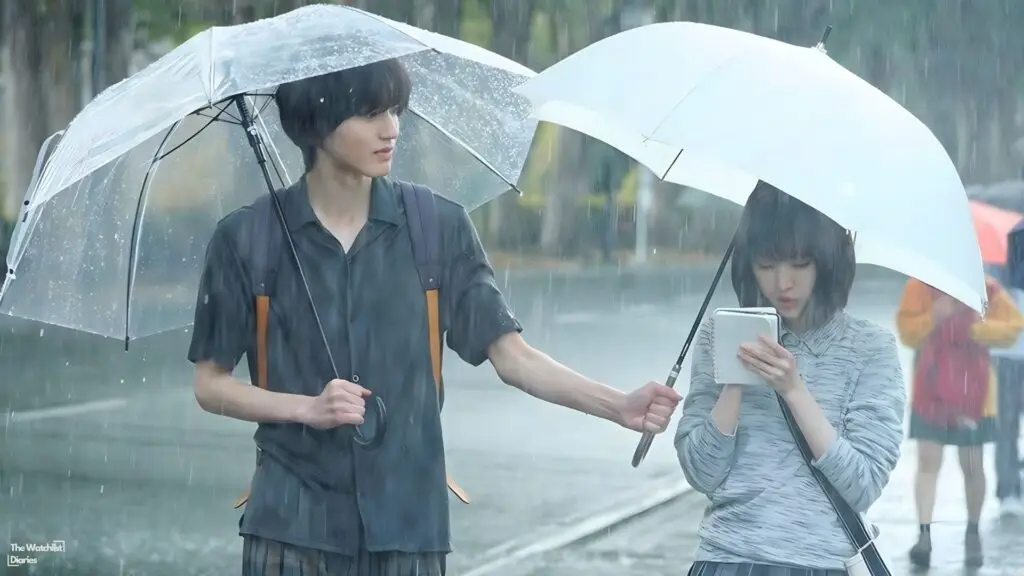
The Korean version is beautiful. The bus scene and the rain confrontation where secrets come out are stunning. Shin Si Ah absolutely sells Han Han Seo-yoon’s confusion and heartbreak. The film feels polished and dreamlike. The cinematography and lighting are pristine.
The Japanese film, though, carries a different texture. The school setting feels authentic. Conversations about books and fangirling over authors feel natural. It grounded the romance in something relatable. Maybe that is personal bias from growing up in a South Asian household in the 2010s. It simply felt believable.
These are small distinctions. They exist only because both films are operating at a very high level.
One of the biggest differences lies in how the story unfolds. The Korean version follows a linear timeline. We see Seo Yoon in school, meeting Kim Jae Won, falling in love, losing him, and then forgetting. It works beautifully. The Japanese version begins at the end.
Maori Hino, played by Riko Fukumoto, is already an adult being able to recall her last day despite her condition. The story is retold through her best friend Izumi Wataya’s perspective as she reads Maori’s hidden diary. That shift in perspective changes the emotional weight of the story.
The burden placed on the friend, which felt slightly underexplored in the Korean adaptation, is given more depth here. You feel the weight of the secret. You understand how close Izumi truly was to Maori and Toru Kamiya.
The Japanese version also expands Toru Kamiya’s family life. We meet his grieving father, who is slowly falling apart after losing his wife. We meet his elder sister Sanae Kamiya, played by Honoka Matsumoto. This character does not exist in the Korean remake. That addition adds depth.
Toru helping Maori no longer feels like a single act of kindness. It reflects who he has always been. He supports his family. He absorbs pain quietly. His obsession with his sister’s writing and how her words helped him through his own grief adds layers to his character.
A deeper look into Jae Won’s family life might have strengthened the Korean film further. A sibling dynamic would have added emotional texture.
You might notice that I keep dissecting differences. That is intentional. These films are separated by small details.
In the Korean version, when Kim Seong-hyeon (played by Jo Han-chul) tells Han Seo-yoon that memories fade but feelings remain, it is powerful. In the Japanese version, when the grieving sister Sanae says something similar and asks Maori to move forward, it lands differently.
Izumi and Toru’s quiet acceptance of their friendship hits harder. The emotional beats feel slightly heavier. It is not a dramatic difference. It is a subtle one and sometimes subtlety wins.
If you are in the mood for an emotional film that respects silence and small gestures, this belongs on your watchlist.
You should watch it if:
This is not a loud romance. It is a gentle one that lingers.
Availability may vary by region. Check it here. The Korean remake is currently available on Netflix in several regions. The 2022 Japanese version may be available through rental platforms or regional streaming services depending on your location. It is worth seeking out the original if you can.
I rated the Korean version 4 out of 5. If I were to rate the Japanese version, I would give it a 4.25. That margin is small. It changes nothing in a practical sense. Both films are beautiful in their own way.
But if you have to pick one, I would recommend starting with the 2022 Japanese version of Even If This Love Disappears from the World Tonight.
Then let yourself sit with it. Sad stories can be beautiful when they are told with care.